
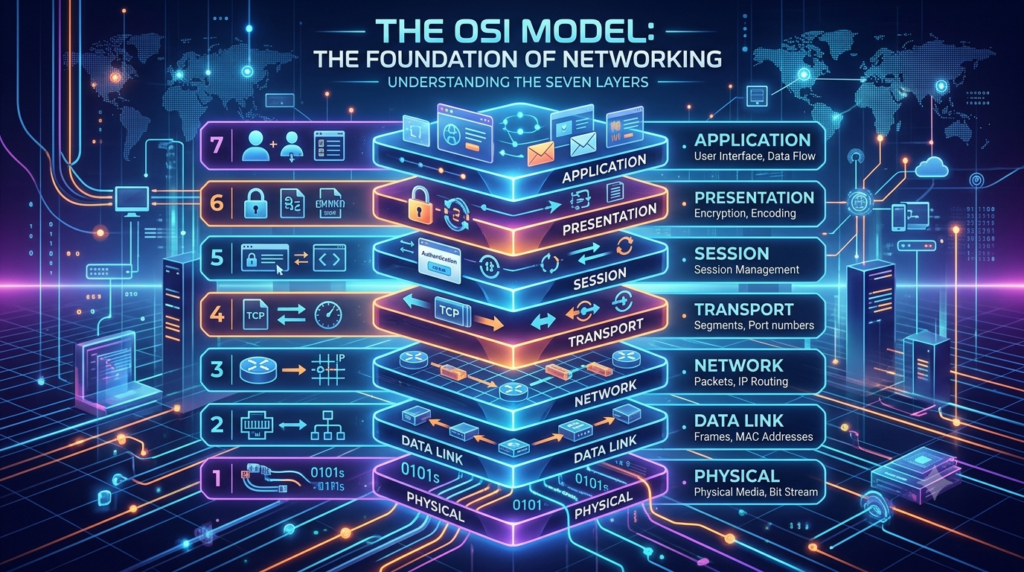
The OSI (Open Systems Interconnection) Model is a conceptual framework that standardizes how different computer systems communicate over a network. It breaks down the complex process of data transmission into seven distinct, manageable layers:
Application: User interface (HTTP/SMTP).
Presentation: Data encryption and formatting.
Session: Manages communication sessions.
Transport: Ensures reliable data delivery (TCP/UDP).
Network: Routes data using IP addresses.
Data Link: Handles physical addressing (MAC) and framing.
Physical: Transmits raw bits over cables or wireless signals.
Each layer serves the one above it, ensuring seamless, universal connectivity across diverse technologies.
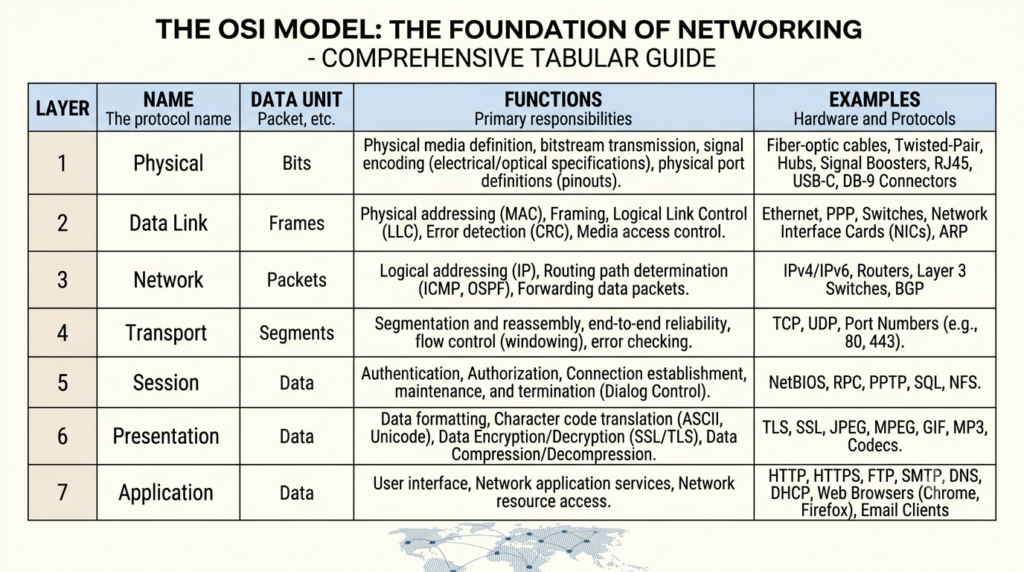
1) At which layer of the OSI Model is data transferred in the form of “packets” ?
OSI मॉडल की किस लेयर (परत) पर डेटा “पैकेट्स” (packets) के रूप में ट्रांसफर होता है?
A. Transport Layer
B. Network Layer
C. Data Link Layer
D. Application Layer
Explanation in English
Data is transferred in the form of “packets” at the Network Layer (Layer 3).
Transport Layer (Layer 4): Breaks large data down into Segments.
Network Layer (Layer 3): Adds IP addresses (source and destination) to those segments, turning them into Packets. This layer is responsible for routing (finding the best path).
Data Link Layer (Layer 2): Puts those packets into Frames and adds MAC addresses.
Physical Layer (Layer 1): Converts everything into raw Bits (0s and 1s) to send over cables or Wi-Fi.
हिंदी में आसान भाषा में समझें
Network Layer (लेयर 3) पर डेटा “पैकेट्स” (packets) के रूप में ट्रांसफर होता है।
इसको आसान शब्दों में समझने के लिए देखें कि डेटा अलग-अलग लेयर्स पर अपना रूप (Data Units) कैसे बदलता है:
Transport Layer (लेयर 4): यहाँ बड़े डेटा को छोटे टुकड़ों में बांटा जाता है, जिन्हें Segments (सेगमेंट) कहते हैं।
Network Layer (लेयर 3): जब इन सेगमेंट्स में भेजने वाले और पाने वाले का IP Address जुड़ जाता है, तो ये Packets (पैकेट) बन जाते हैं। इसी लेयर पर राउटर (Router) तय करता है कि डेटा किस रास्ते से जाएगा।
Data Link Layer (लेयर 2): इन पैकेट्स को और सुरक्षित करके Frames (फ्रेम) में बदल दिया जाता है और MAC Address जोड़ा जाता है।
Physical Layer (लेयर 1): अंत में, सब कुछ Bits (बिट्स – 0 और 1) में बदल जाता है ताकि तारों (cables) या वाई-फाई के ज़रिए भेजा जा सके।
Q 2. Which Layer words to encrypt and decrypt data ?
OSI मॉडल की कौन सी लेयर (परत) डेटा को एनक्रिप्ट (encrypt) और डिक्रिप्ट (decrypt) करने का काम करती है?
A. Session Layer
B. Transport Layer
C. Presentation Layer
D. Network Layer
Explanation in English
The Presentation Layer (Layer 6) is responsible for data encryption and decryption.
How it works: When you send sensitive data (like passwords or credit card numbers), this layer encrypts it (scrambles it into unreadable code) so hackers cannot steal it during transmission. When the data reaches the receiver, this same layer decrypts it back into its original, readable format.
Other Roles: It also handles data compression (making files smaller) and translation (converting data formats like JPEG, MP3, or ASCII).
हिंदी में आसान भाषा में समझें
डेटा को सुरक्षित करने के लिए उसे छुपाना (Encryption) और वापस असली रूप में लाना (Decryption), यह काम Presentation Layer (लेयर 6) का होता है।
यह कैसे काम करता है: जब आप इंटरनेट पर कोई ज़रूरी जानकारी (जैसे पासवर्ड या बैंक डिटेल्स) भेजते हैं, तो यह लेयर उसे एक गुप्त कोड (Encrypt) में बदल देती है ताकि बीच में कोई उसे चुरा न सके। जब वह डेटा सामने वाले के पास पहुँचता है, तो यही लेयर उसे वापस सामान्य भाषा में बदल (Decrypt) देती है।
अन्य काम: इसका काम डेटा को कंप्रेस (फ़ाइल का साइज़ छोटा करना) और ट्रांसलेट (जैसे JPEG, MP3, या ASCII फॉर्मेट को संभालना) करना भी होता है।
Q 3. TCP and UDP work on which OSI layer ?
TCP और UDP OSI मॉडल की किस लेयर (परत) पर काम करते हैं?
A. Application layer
B. Transport layer
C. Network layer
D. Data link layer
Both TCP and UDP work on the Transport Layer (Layer 4) of the OSI Model.
The Transport Layer is responsible for establishing end-to-end communication and managing how data is delivered between devices. It uses two completely different protocols depending on what the application needs:
TCP (Transmission Control Protocol): Focuses on reliability. It creates a secure connection before sending data, checks for errors, and ensures all data arrives safely in the correct order. (Used for: Web browsing, emails, file downloads).
UDP (User Datagram Protocol): Focuses on speed. It sends data immediately without checking if the receiver is ready or if the data got lost. (Used for: Live video streaming, online gaming, voice calls).
हिंदी में आसान भाषा में समझें
TCP और UDP दोनों OSI मॉडल की Transport Layer (लेयर 4) पर काम करते हैं।
Transport Layer का मुख्य काम दो डिवाइस के बीच डेटा ट्रांसफर को संभालना होता है। यह ज़रूरत के हिसाब से दो अलग तरीकों (Protocols) का इस्तेमाल करती है:
TCP (Transmission Control Protocol): यह भरोसेमंद (Reliable) होता है। डेटा भेजने से पहले यह एक पक्का कनेक्शन बनाता है, यह चेक करता है कि पूरा डेटा सही सलामत पहुँचा या नहीं, और डेटा को सही क्रम (order) में लगाता है। (इस्तेमाल: वेबसाइट खोलने, ईमेल भेजने या डाउनलोडिंग में)।
UDP (User Datagram Protocol): यह बहुत तेज़ (Fast) होता है। इसे इस बात से फर्क नहीं पड़ता कि डेटा बीच में गायब हुआ या नहीं, यह बस बिना रुके लगातार डेटा भेजता रहता है। (इस्तेमाल: लाइव वीडियो, ऑनलाइन गेमिंग या वॉइस कॉल में)।
Q 4. Which of the following is not a function of the physical layer of the OSI Model ?
निम्नलिखित में से कौन सा OSI मॉडल की फिजिकल लेयर (Physical Layer) का कार्य नहीं है?
A. Converting bits into electrical signals बिट्स (bits) को इलेक्ट्रिकल सिग्नल्स में बदलना।
B. Routing data packets डेटा पैकेट्स को रूट करना (सही रास्ता दिखाना)।
C. Using cables and connectors केबल्स और कनेक्टर्स का उपयोग करना।
D. Signal transmission सिग्नल ट्रांसमिशन (सिग्नल्स को आगे भेजना)।
Correct Answer: B. Routing data packets सही उत्तर: B. Routing data packets (डेटा पैकेट्स को रूट करना)
Explanation in English
Why Option B is NOT a function of the Physical Layer: Routing data packets is the primary job of the Network Layer (Layer 3) using devices like routers. The Physical Layer does not understand packets or IP addresses.
Why Options A, C, and D are incorrect: Converting bits to signals, using cables/connectors, and transmitting signals are all core responsibilities of the Physical Layer (Layer 1), as it deals directly with the physical hardware and electrical media.
हिंदी में आसान भाषा में समझें
विकल्प B क्यों Physical Layer का काम नहीं है: डेटा पैकेट्स को सही रास्ता दिखाना (Routing) Network Layer (लेयर 3) का मुख्य काम होता है, जिसे राउटर (Router) संभालता है। Physical Layer को पैकेट्स या IP एड्रेस की कोई समझ नहीं होती।
बाकी विकल्प (A, C, और D) क्यों गलत हैं: बिट्स को सिग्नल्स में बदलना, तारों (cables/connectors) का इस्तेमाल करना और सिग्नल्स को आगे भेजना—यह सारे काम Physical Layer (लेयर 1) के ही हैं, क्योंकि इसका सीधा संबंध नेटवर्क के भौतिक सामान और बिजली के सिग्नल्स से होता है।
Q 5: In the Transport layer of the OSI model, which of the following protocols provides connectionless data transmission?
प्रश्न: OSI मॉडल की Transport layer (ट्रांसपोर्ट लेयर) में, निम्नलिखित में कौन सा प्रोटोकॉल कनेक्शनलेस (connectionless) डेटा ट्रांसमिशन प्रदान करता है?
A. TCP
B. SMTP
C. FTP
D. UDP
Correct Answer: D. UDP सही उत्तर: D. UDP
Quick Summary (संक्षिप्त विवरण)
English: UDP is connectionless because it sends data directly to the destination without setting up a connection beforehand or checking if the data arrived safely. This makes it super fast for gaming or live streaming.
हिंदी: UDP कनेक्शनलेस है क्योंकि यह डेटा भेजने से पहले कोई कनेक्शन नहीं बनाता और न ही यह चेक करता है कि डेटा पहुँचा या नहीं। कनेक्शन बनाने में समय न गँवाने के कारण यह गेमिंग और लाइव स्ट्रीमिंग के लिए बहुत तेज़ काम करता है।